

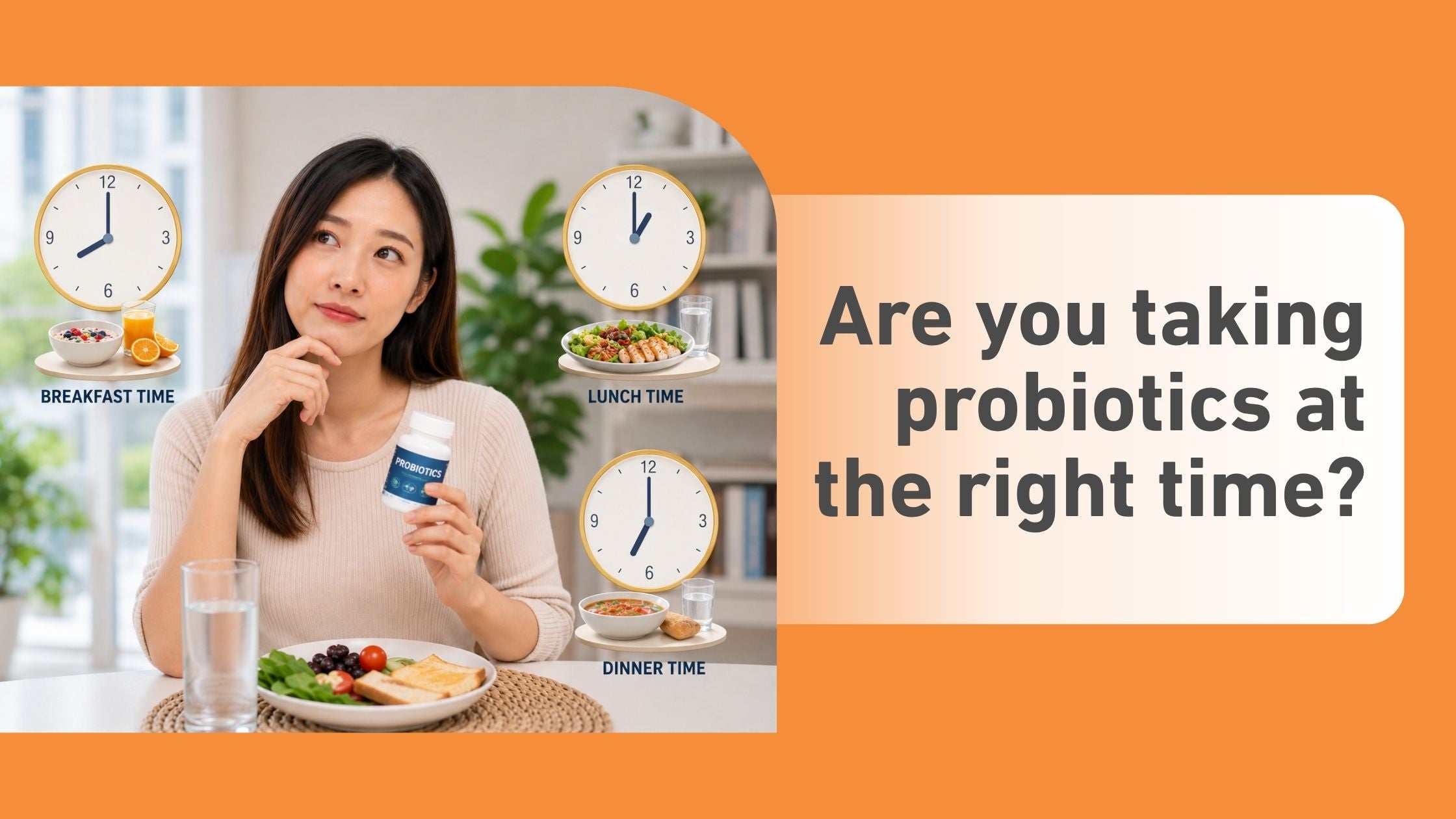
You take your probiotic every morning. But depending on when and how you take it, a significant proportion of those bacteria may not survive long enough to reach your intestines. Timing, formulation and strain all influence the likelihood of bacterial survival and effectiveness and most labels don't explain the difference.
Quick Answer
Take most probiotic supplements either:
- 30 minutes before a meal as stomach acid is lower before eating, improving bacterial survival
- With food as food buffers stomach acid and protects bacteria during transit.
- Delayed-release (enteric-coated) and spore-based formulations are less timing-sensitive because they resist acid independently of meal state.
Key Takeaways
- Probiotic bacteria must survive stomach acid (pH 1.5-3.5) to reach the intestines
- A study in Beneficial Microbes found Lactobacillus and Bifidobacterium strains survived best when taken 30 minutes before or during a meal
- Most probiotic strains do not permanently colonise the gut; daily intake is required to sustain effects
- Antibiotics and probiotics should be spaced at least 2 hours apart for most strains
- Strain identity matters as much as timing; not all probiotics do the same thing
Does Timing Affect Probiotic Effectiveness?
Yes, for standard formulations but the degree depends on the strain. Probiotic bacteria must pass through stomach acid before reaching the intestines, where they interact with the gut microbiome. Research has found that Lactobacillus and Bifidobacterium survived best when taken up to 30 minutes before a meal. Saccharomyces boulardii survived equally with or without food. Meals containing healthy fats (dairy, meat, fish) offered more protection than acidic foods such as citrus or coffee.
Important caveat: A University of Milan study in the World Journal of Gastroenterology found that for B. longum BB536 and L. rhamnosus HN001, meal timing did not significantly affect gut microbiota changes. Optimal timing is strain-specific, not universal.
Which Probiotic Strain Is Right for Your Goal?
This is the question most people are actually searching and timing guides rarely answer it. Strain identity determines what a probiotic does. The table below reflects strains with the strongest current clinical evidence.

(Note: "Evidence strength" reflects current research consensus, not marketing claims.)
Many conditions including immune boosting, mental health lack sufficient clinical evidence for specific strains to be recommended.
Morning vs Night: Does It Matter?
No strong evidence supports morning probiotics being universally superior. Consistent daily use matters more than the hour. Research also notes that even 3-5 times per week may be sufficient to support colonisation for some people. Pick a time that fits your routine and repeat it daily.
Taking Probiotics With Antibiotics
Antibiotics kill both harmful and beneficial bacteria. Spacing matters but varies by strain:
- S. boulardii and L. rhamnosus GG can be taken alongside antibiotics in some protocols, as both resist common antibiotic action.
- Most Lactobacillus and Bacillus strains take 1-2 hours before or after the antibiotic dose
- Continue probiotics for at least 2 weeks after finishing antibiotics to support microbiome recovery
- NCCIH identifies antibiotic-associated diarrhoea as the most consistently supported indication for probiotic use across clinical research.
Do Probiotics Permanently Colonise the Gut?
No. According to microbiome experts, Lactobacillus strains persist approximately 2-3 days after ingestion; Bifidobacteria persist 5-7 days. Neither colonises the gut permanently in healthy adults. Stopping supplementation typically returns the microbiome toward its baseline within days to a week. This is why daily use is necessary and why probiotics are not a one-time fix.
Who Should Not Take Probiotics Without Medical Advice
Probiotics are generally well-tolerated in healthy adults, but carry meaningful risk for:
- Immunocompromised individuals, including those on chemotherapy, organ transplant recipients or people with HIV
- Premature infants: The FDA issued a 2023 warning about severe and potentially fatal infections in premature infants given probiotic supplements
- Post-surgical patients, particularly those with compromised gut barriers
- People with central venous catheters risk of bacteraemia from translocation
If you fall into any of these groups, consult a doctor before starting any probiotic supplement.
What Actually Affects Gut Health
Probiotic timing is a minor variable. These factors have stronger, well-documented effects on the gut microbiome:
- Dietary fibre: The primary fuel for beneficial gut bacteria; most adults consume far below the recommended 25-38g daily
- Sleep: Disrupted circadian rhythms measurably alter microbiome composition
- Chronic stress: It elevates cortisol, which suppresses beneficial bacterial populations
- Antibiotic history: Single antibiotic courses can alter microbiome diversity for months
- Diet quality: Ultra-processed food reduces microbial diversity independent of supplement use
Fermented foods (kimchi, miso, tempeh, kefir, yoghurt) support microbial diversity but probiotic supplements deliver specific strains at defined doses that fermented foods do not reliably replicate.
Common Probiotic Myths; And What the Research Actually Shows
Much of what people believe about probiotic supplements comes from marketing, not research. The five misconceptions below are the most frequently repeated across product labels, wellness blogs and social media. And each one leads people toward either the wrong supplement or the wrong expectation.

How to Build a Simple Probiotic Routine
Match the strain to your goal: Use the evidence table above as a starting point
Take it 30 minutes before a meal or with food, whichever you will do every day
Store correctly as some probiotics require refrigeration; all degrade in heat and humidity.
Increase dietary fibre as probiotics work better in a fibre-rich gut environment
Wait 2-4 weeks before evaluating: Microbiome changes are gradual
During antibiotics: Space doses by at least 2 hours; continue for 2 weeks after completing the course
Frequently Asked Questions
1. What is the best time to take probiotics?
The best time to take probiotics is 30 minutes before a meal or with food. Both reduce stomach acid exposure during transit. Consistency matters more than the exact hour.
2. Can you take probiotics on an empty stomach?
Some formulations are less sensitive to stomach acid exposure (enteric-coated and spore-based). Standard capsules generally do better with food buffering the acid.
3. How long does it take for probiotics to work?
Allow 2-4 weeks of daily use before evaluating. Microbiome changes are gradual and vary by individual and strain.
4. What happens when you stop taking probiotics?
Most strains clear within 2-7 days. Probiotics do not permanently colonise the gut, so effects typically reverse after stopping.
5. Are probiotics safe for everyone?
No. People who are immunocompromised, post-surgical, or have central venous catheters should consult a doctor first. The FDA issued a 2023 warning about serious infection risk in premature infants given probiotics.
Find the Right Probiotic for Your Goals
Most probiotic supplements are sold as generic blends. iAM Health formulates around specific researched strains, matched to defined health goals including gut health, digestive comfort and women's intimate health, designed for the dietary patterns and lifestyle demands common across Asian urban environments.
If the strain table in this guide raises questions about what you are currently taking, it may be worth reviewing whether your supplement matches your actual goal.
Explore iAM Health probiotic supplements on iamhealth.live
References Used:
- https://www.scitechnol.com/peer-review/juicebased-living-probiotics-survive-stomach-acid-significantly-better-than-dry-powder-live-probiotics-euGD.php?article_id=26908
- https://www.drugs.com/medical-answers/probiotics-with-antibiotics-3121702/
- https://pubmed.ncbi.nlm.nih.gov/22146689/
- https://link.springer.com/article/10.1007/s12325-024-02783-3

